
Established DNA testing services for forensic analysis of criminal cases and parentage identification, supporting the judicial system and law enforcement agencies
Research laboratory
Forensic Research
The Forensic DNA Typing Laboratory provides DNA testing for parentage, maternal cell contamination, paternal lineage and animal DNA, and develops new STR multiplex and forensic phenotyping protocols.
Research and casework
From evidence to answers the courts can rely on.
The laboratory at CEMB, University of the Punjab, offers DNA testing services for parentage analysis, maternal cell contamination (MCC) in CVS, paternal lineage, animal DNA testing, breed identification and bird sex determination. It also promotes research on new STR multiplex protocols, forensic DNA phenotyping, age prediction and population genetics, alongside technical training and collaboration in forensic genetics.
Forensic DNA typingPopulation geneticsDNA phenotyping
- 3,500+
- forensic cases solved
- 20,000+
- samples analysed
- ~267
- samples from external clients
- 3
- current research scholars
Research programme
Four strands of forensic genetics.
Routine testing services sit alongside research that builds new protocols, databases and predictive tools.
- 01
DNA testing services
Parentage analysis, maternal cell contamination (MCC) testing in CVS and paternal lineage testing.
- 02
Animal DNA testing
Animal DNA testing, breed identification and bird sex determination.
- 03
STR & phenotyping research
New protocols for STR multiplex development, forensic DNA phenotyping and age prediction.
- 04
Population genetics & training
Population genetics, technical training and collaboration in the field of forensic genetics.
Translation & outcomes
Casework and capacity at national scale.
Thousands of forensic cases, specialised testing services and sustained training in forensic genetics.
Solved approximately 3,500+ forensic cases (20,000+ samples), including criminal and parentage testing
Developed and provided maternal cell contamination (MCC) testing in chorionic villus sampling (CVS) specimens
Initiated animal DNA testing services, including PKD1 disease and coat colour/size identification
Developed a DNA testing protocol and service for bird sexing
Received approximately 267 samples from external clients and institutions, generating revenue through laboratory testing services
Validated a commercial real-time PCR system to support molecular testing capabilities
Strengthened research collaboration, technical training and capacity building in forensic DNA analysis
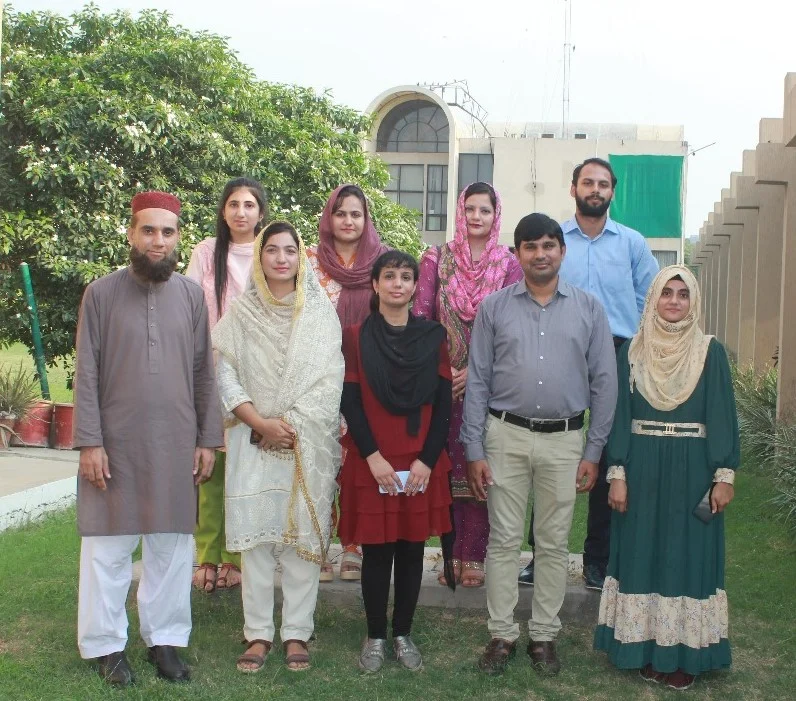
Research group
Faculty leading the programme.
Expertise in forensic DNA typing, STR development, population genetics and genetic epidemiology.


Research students
The questions shaping forensic genetics.
1 PhD scholars2 MPhil scholars
PhD research scholars 1

Zarqa Rani
PhD Research ScholarGenetic risk prediction model for suicidal behaviour based on polygenic SNP associations
MPhil research scholars 2

Ammara Ilyas
MPhil Research ScholarDecoding blood-based mRNA–miRNA signatures across glutamatergic, neurotrophic and serotonergic systems in suicidal behaviour of psychiatric patients

Saleha Ilyas
MPhil Research ScholarIdentification of mRNA–miRNA-based molecular signatures of SAT1, SKA2, NR3C1, NR3C2 and MAOA in suicidal behaviour among psychiatric patients
Research funding
Research funded from national databases to behavioural genetics.
Projects supported by the Pakistan Science Foundation, HEC, PCSIR and the University of the Punjab.
Active projects
Completed projects
Collaborate with the lab